
I Wrote a Book.
Dum Spiro Spero. Fieldnote #14

Dum Spiro Spero
The photo gallery depicts a Palestinian woman watering a garden plot. The flowers she cares for bloom out of jagged army-green containers; she mends tear gas canisters. Their contents, not so long ago depleted, are now filled instead with the soil of her home in the West Bank. Dum Spiro Spero. A child in Afghanistan flies a kite made out of plastic bags and reeds in the dry desert air. Dum Spiro Spero. A mother in Kenya holds her child in one arm while standing on the street, selling an eclectic collection of pots and pans. Dum Spiro Spero.
While I breathe, I hope.
Over the past three years, I’ve spent a lot of time thinking about Hope. Capital H, Hope—more than just the “desire or anticipation for something to happen or be true,” as described by Merriam-Webster. I mean the type of Hope that finds you at the bottom of the well, the one that holds your hand while navigating the staircase of despair, the one that says calmly in a world that screams for you to be scared, apathetic, and fearful, “I am here with you. Together, we are boundless.” I have been thinking of that Hope.
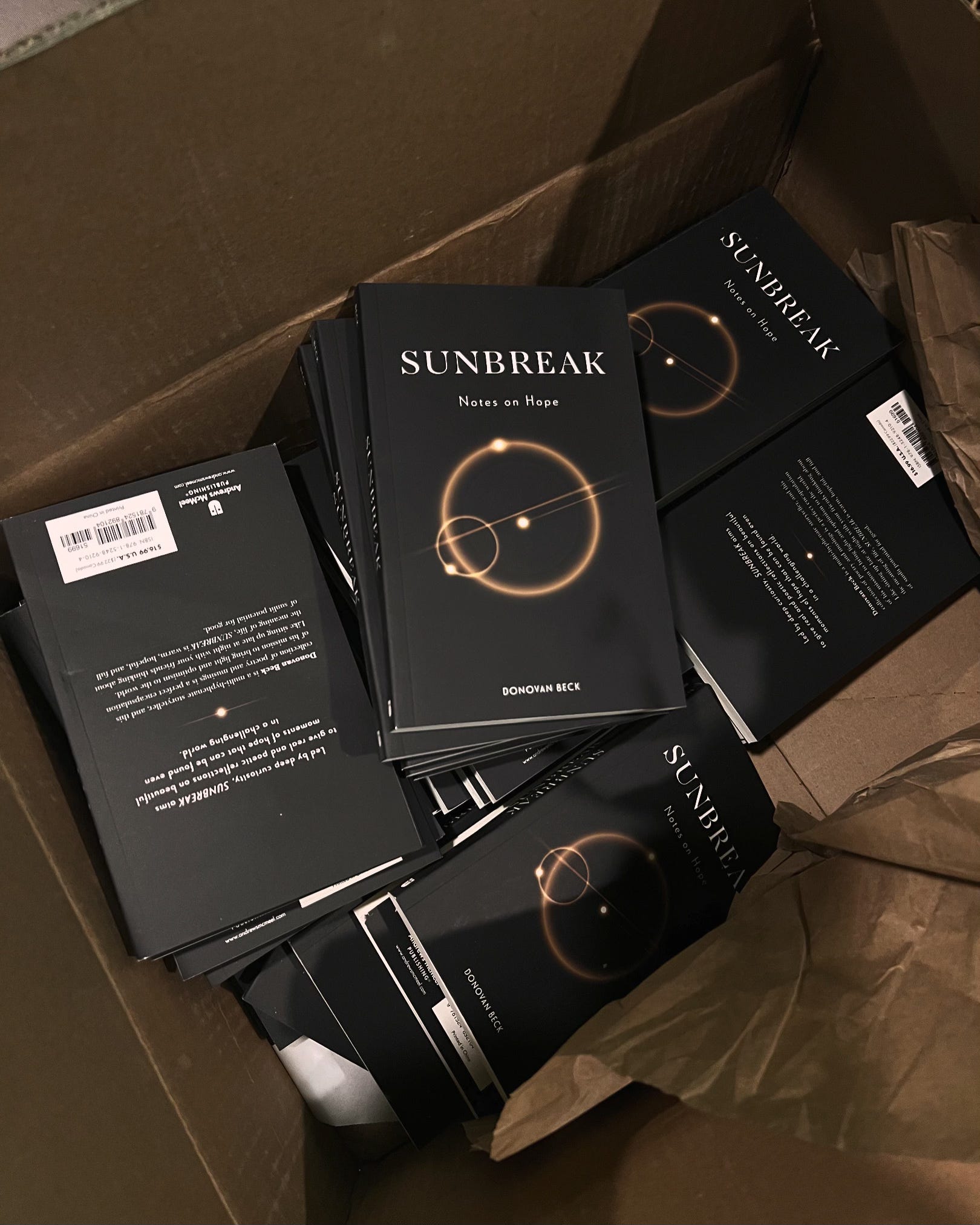
Today, my second book, Sunbreak: Notes on Hope, releases. It is a surreal feeling, if I am being honest. The story of this book deserves a longer entry than just a short newsletter, but I write this to you from seat 23F at 33,000 feet, cruising altitude on my way to San Francisco for the first time in years. When I set out to write Sunbreak, I knew two things for sure—and learned one more important lesson during the journey. That is what I write about here.
The Things I Knew:
In a world as burned and bruised as ours, we have no other option but to hold Hope closely. Sunbreak is a collection of poems and short essays on what I believe is the aftermath of despair: Hope. It is undeniable that today we are facing countless reasons to lose hope—war, political corruption, climate change, food insecurity. The list goes on. And in such a world, it feels like the last thing we should do is put our belief on the whims of some word like Hope. But I think it is important to highlight that in the face of all of this despair, both today and historically, humanity has come out on the other side. Not always immediately, but always eventually. And I think that is beautiful.
With that in mind, you must always remember: if you look, you will find. Today’s attention economy has a way of choosing what you do and don’t see, which ultimately dictates what you do or don’t care about. Some of the most immediate feedback I received when I told people early on that I was writing a book about hope—and wanted to include short essays on stories, anecdotes, and examples of Hope out in the world—was, “There can’t be that many examples of what you are describing. Maybe just focus on poetry.” (Fun fact: This was the feedback from one of the first literary agents to ever respond to me about the book.) But this is not true. If you look, you will find—it is just unfortunate that most of the time, we are looking for despair rather than hope. And we find it…easily. We find every reason to rightfully believe our world is falling apart. I am not arguing to ignore what is blatantly obvious, but I am advocating for taking a step back some days and really looking at the town, city, state or country you live in, watching for the little interactions of hope that you will also undoubtedly find.
In writing this book, I spent a lot of time diving down rabbit holes of the internet to find obscure stories of people doing extraordinary things simply to try and make their world better. (See the story of Dashrath Manjhi in the book.) In times of despair, do not put your head down—look, and you will find hope, even if it’s just in small bits. I promise you this.
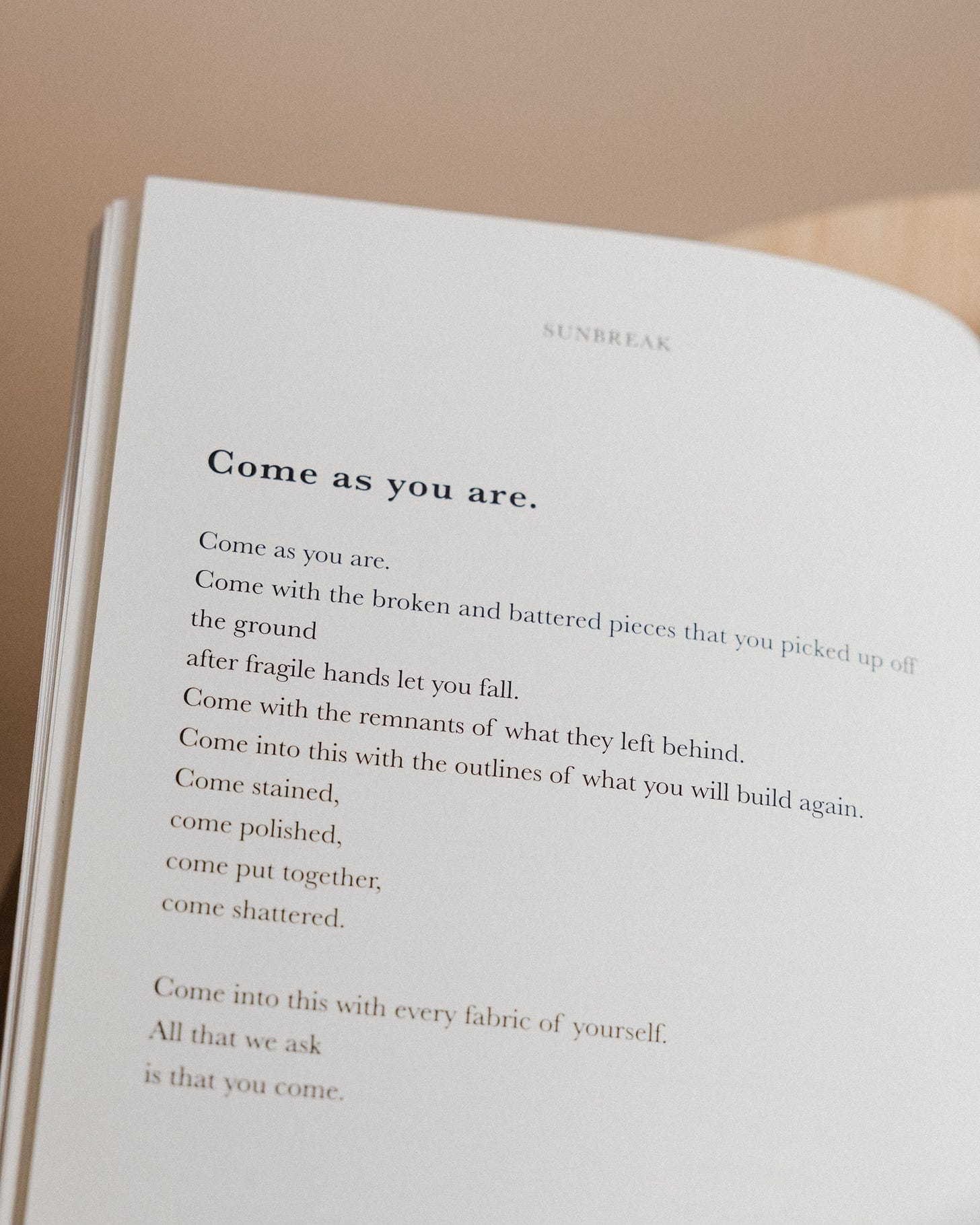
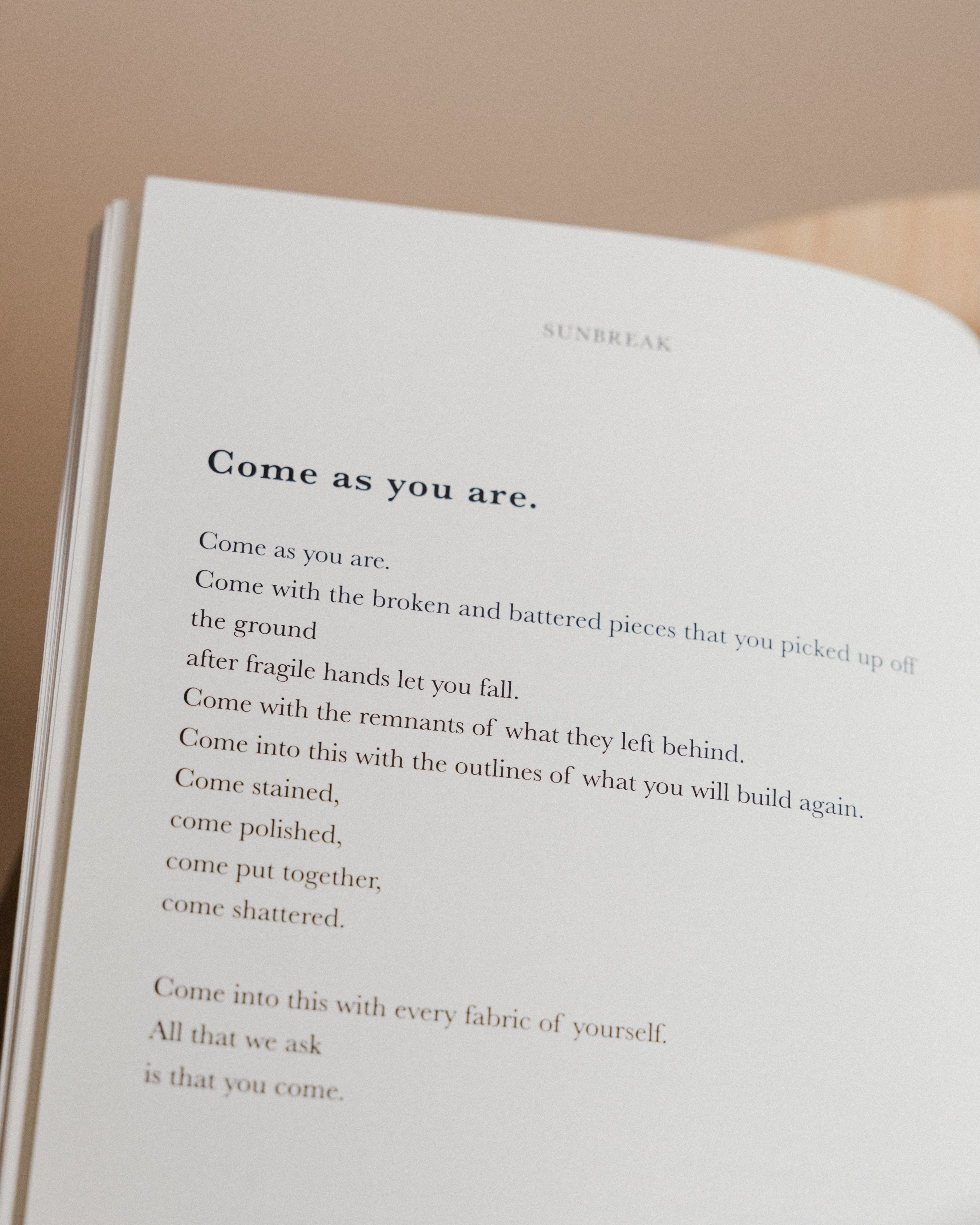
“Come as you are.” Poem from Sunbreak: Notes on Hope
These two things I knew at the start of this book. But one realization came in the midst of its writing: To understand Hope, you must also learn to understand despair.
I will keep this section brief, in the hope of writing another, longer newsletter later about my lessons learned writing Sunbreak. But this work is the culmination of three years of my life—a move across the country to a brand-new city, working in a brand-new career. It is a collection of many sleepless nights, panic attacks, and questioning why I do anything. Not just why do I write or make films?—but why do I try? Why do I show up? Why do I not?
Becoming intimate with Hope is also an exercise in becoming intimate with despair—to learn to sit with both in the same room and say, “Despair, I see you. I understand you are a reflection of myself and the parts that are still growing and mending themselves, time and time again. Hope, I see you. I understand you are a reflection of myself and the parts that are still learning that nothing is linear. Tomorrow will come, and I will be ready. Both of you, thank you for all that you offer me.”
There were many days I wanted to push the delete button on this project, mornings when I drafted a final apology email to my editors, agent, and publishers—wishing I could just close off this project as some farce of a dream. But at the end of it all, I found the above Latin phrase as a guidepost. Dum Spiro Spero—While I Breathe, I Hope.
Sunbreak: Notes on Hope is out in the world now. It is no longer just mine; I can no longer hover over the delete button. So instead, this morning, in seat 23F at 35,000 feet, I hover over the publish button of this newsletter and say—
I wrote a book. I hope you enjoy it. I hope you find hope in what is out there.

Sent with love,
Donovan Alexander Beck
33,000ft over the Rocky Mountains.
This brought tears to my eyes. I’m proud of you, friend!